
 FUL1
FUL1 MAN1
MAN1 BOU0
BOU0 LIV1
LIV1 LEE0
LEE0 CRY0
CRY0 MNC5
MNC5 SUN3
SUN3 NOR3
NOR3 BOL4
BOL4 WOL1
WOL1 WBA0
WBA0 BHA1
BHA1 AVL1
AVL1 CRY0
CRY0 TOT7
TOT7 WHU0
WHU0 EVE1
EVE1 CEL0
CEL0 RAN1
RAN1 NCD
NCD SOL
SOL FIJ
FIJ VAN
VAN DMA
DMA AIA
AIA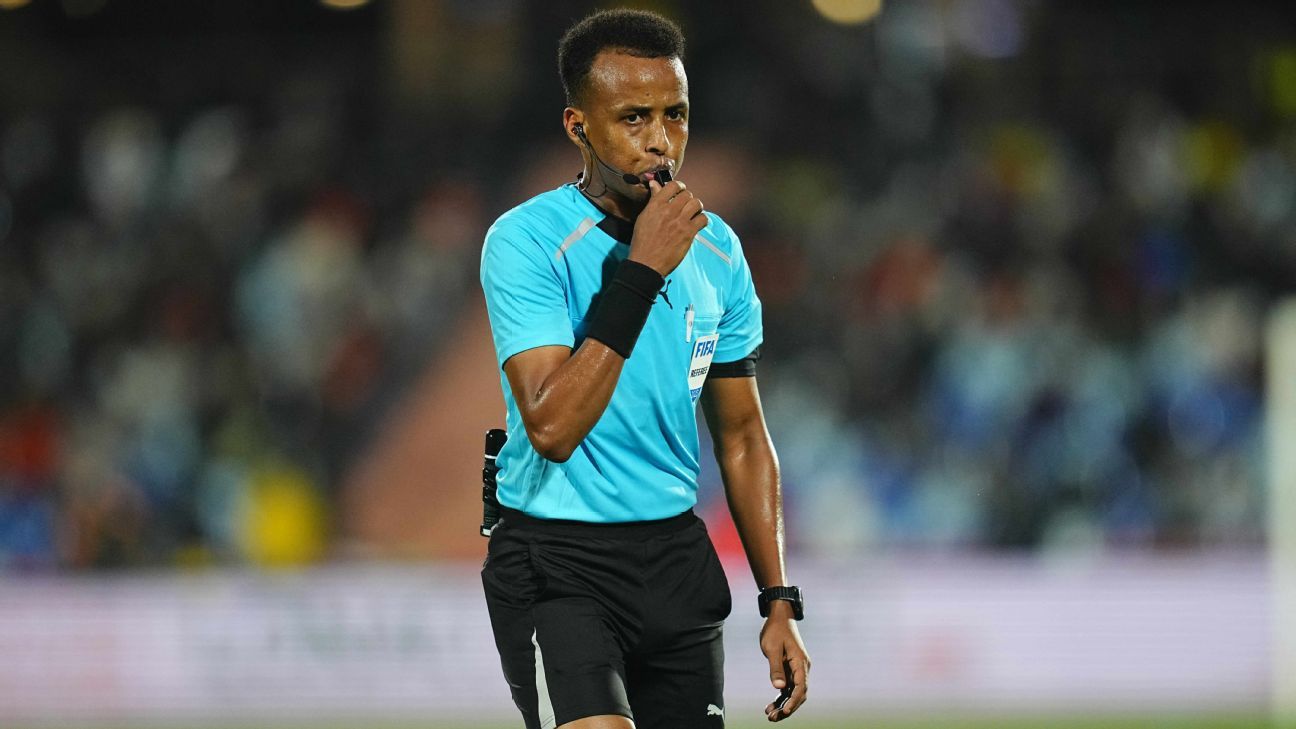
Photo: ESPN FC
The ref who lost his World Cup — and found a way back
Omar Artan had worked his entire career toward a World Cup. Then a travel ban took it away — not a red card, not a fitness test, not a governing body's decision about his officiating. A geopolitical wall, and his name on the wrong side of it. The Somali referee has now spoken publicly about what that period was like, and about the gratitude he feels for being handed a major assignment — the Super Cup — after the door to the United States was shut in his face.

A dream that didn't make it through customs
Artan's situation cuts to something football's governing bodies rarely have to confront directly: the sport's biggest tournaments are staged in countries with their own border policies, and those policies don't pause for referees with FIFA badges. According to ESPN FC, Artan was denied entry to the United States ahead of the 2026 World Cup — a tournament that, for officials as much as players, represents the pinnacle of the game.
The specific grounds for his refusal haven't been confirmed in detail in the ESPN FC report. What Artan himself has confirmed, per that report, is that the period was genuinely difficult. That much you'd expect. What's less expected is the composure with which he's talking about it now.
The Super Cup as a lifeline
Rather than disappear from the conversation, Artan has been given a high-profile assignment — officiating at the Super Cup — and he's described the opportunity as something he's genuinely grateful for, according to ESPN FC. That word, "grateful", does a lot of work here. It's the language of someone who has recalibrated, not someone who has been made whole.
For a referee at the level where World Cup selection is realistic, every major tournament is a short window. Careers in elite officiating don't stretch indefinitely. Missing a World Cup isn't a setback you simply reschedule around.
FIFA selects the officials. It can't guarantee they get in.
Artan's story sits at a junction football doesn't always handle well. FIFA can select its officials. It cannot guarantee those officials can travel. The 2026 World Cup — hosted across the United States, Canada, and Mexico — was always going to expose that tension. It is editorial inference, not a detail confirmed by the ESPN FC report, that US entry restrictions affecting nationals from certain countries played a role in Artan's specific case; the precise grounds remain unconfirmed.
There's no suggestion FIFA failed Artan through any officiating decision. The question his case raises is a structural one: what responsibility does a host nation, or a governing body, carry when a qualified official is locked out not by merit but by passport?
He didn't get an answer to that. He got a Super Cup instead. And he's choosing to treat it as a beginning rather than a consolation — which, honestly, takes more character than most post-match press conferences ever reveal.
All factual claims in this article are drawn from a single ESPN FC report. Flagside will update if additional sourcing becomes available.
Sources1 source
Flagside's editors read every piece we publish. We work from the football press, write our own copy rather than reprinting anyone's, and check each article for accuracy and sourcing. Every outlet that fed into this piece is named under Sources.


The day's football, in your inbox at 7 AM. Nothing else.
Pick of the night's matches, what the transfer window's doing, and the one column you should read today. No ads. No tips. No operators.
One-click unsubscribe. We do not share emails.
Comments
Loading comments…