
 FUL1
FUL1 MAN1
MAN1 BOU0
BOU0 LIV1
LIV1 LEE0
LEE0 CRY0
CRY0 MNC5
MNC5 SUN3
SUN3 NOR3
NOR3 BOL4
BOL4 WOL1
WOL1 WBA0
WBA0 BHA1
BHA1 AVL1
AVL1 CRY0
CRY0 TOT7
TOT7 WHU0
WHU0 EVE1
EVE1 CEL0
CEL0 RAN1
RAN1 NCD0
NCD0 SOL2
SOL2 FIJ
FIJ VAN
VAN DMA
DMA AIA
AIA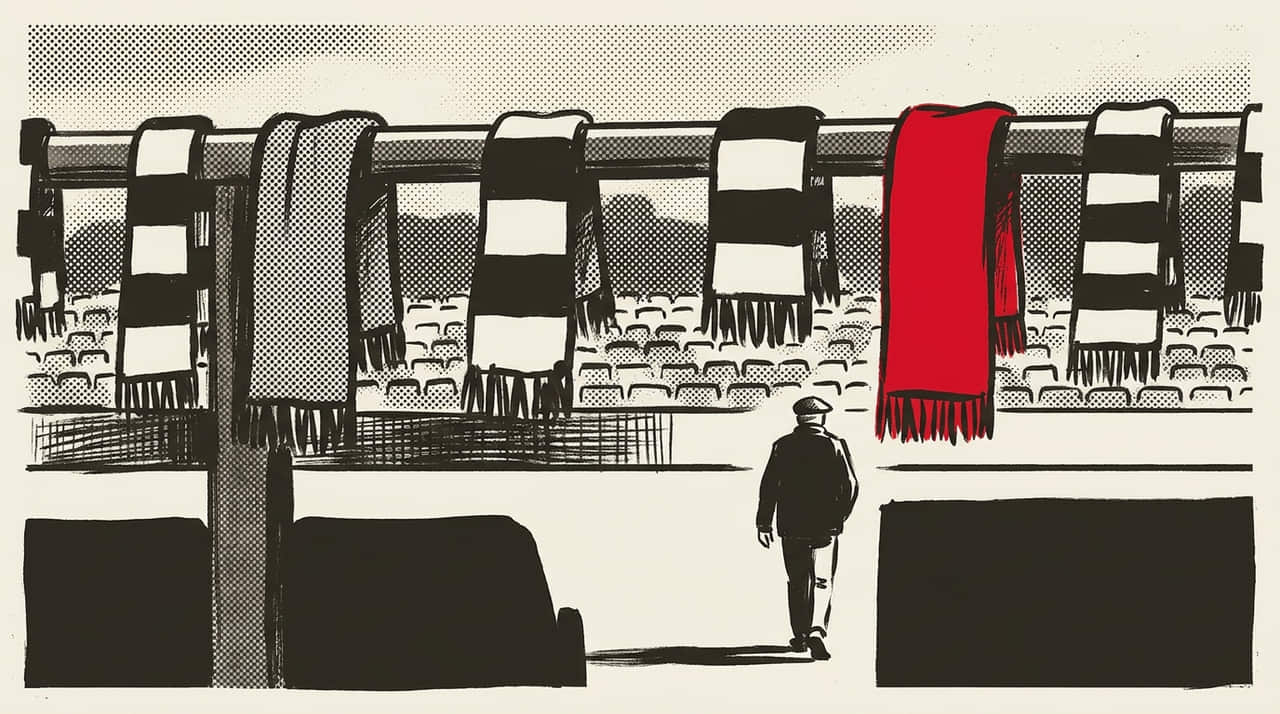
ILLUSTRATION — FLAGSIDE
The case against biased co-commentators
Sky Sports keeps putting Gary Neville on Manchester United games, Jamie Carragher on Liverpool games and Martin Keown on Arsenal games, and it keeps annoying fans of those exact clubs. The idea that broadcasters should use only neutral voices sounds clean in theory. In practice it misunderstands why those pundits are there in the first place.

The complaint is real, and it's not new
Every big United game, Neville is in the gantry. Every big Liverpool game, there's a decent chance it's Carragher. Arsenal get Keown with startling regularity. Fans of those clubs have spent years arguing that the men who spent their careers at Old Trafford, Anfield and Highbury cannot possibly call their old side straight, and that the frustration cuts both ways: too critical reads as betrayal, too soft reads as an agenda. Either way, the fan feels like the coverage isn't really about the match anymore, it's about the pundit's relationship with the club.
Why broadcasters do it anyway
Sky, TNT and the rest are not choosing these pairings by accident. Neville, Carragher and Keown are not on air because they're neutral, they're on air because they know the inside of those specific dressing rooms in a way a generalist never will. They can read a shape United are trying to play because they played in a version of it themselves, or explain why a Liverpool full-back is drifting inside because they spent a decade being told to do exactly that. Insider knowledge and impartiality are, in commentary, mostly opposite qualities. A broadcaster chasing pure neutrality gets a pundit who can describe what happened but not always why, and modern football coverage is built around the why.
The bias is usually smaller than it feels
Part of the frustration fans describe is a mismatch between what they want (validation) and what a pundit is paid to do (analysis with an edge). Neville criticising United, Carragher criticising Liverpool and Keown criticising Arsenal is, more often than not, the pundit doing the job properly rather than doing it with an agenda. It only reads as bias because a fan watching their own team wants a friendlier voice in that moment, and a genuinely tough but fair take from someone with United history lands differently to the same take from a stranger. That doesn't mean the complaint is baseless: pundits do occasionally overcorrect, either being harder on their old club to prove they're not soft, or protective of it in ways that dodge the obvious question. Both failure modes exist, and fans notice both.
Would a fully neutral panel actually be better?
Probably not, and for a simple reason: total neutrality tends to flatten commentary into description. The best broadcast pairings usually mix a former player with genuine club history alongside a co-commentator with no allegiance at all, precisely so the emotional read and the neutral read sit next to each other. Remove every pundit with a boyhood or professional tie to either team and you lose most of the analysts who actually understand dressing rooms, tactical culture and the specific pressures at a specific club, in favour of commentators who can only offer generic observation. Fans would trade a bias problem for an insight problem, and the insight problem is worse for the actual broadcast.
The real fix isn't a blanket ban
The fairer version of the complaint isn't "no connected pundits, ever", it's "don't repeatedly stack the same pundit on the same club's biggest games until the relationship becomes the story". Rotating who covers which fixtures, pairing an ex-player with a genuinely neutral co-commentator, and being honest on air about a pundit's history with a club would do more to solve the trust problem than removing every recognisable voice from the gantry. Broadcasters have leaned into the Neville-United and Carragher-Liverpool dynamic because it generates exactly the reaction this topic describes: strong feelings, clips that travel, an audience that keeps watching to see what the old boy says about his old club. That's a commercial decision as much as an editorial one, and it's unlikely to change while the ratings keep rewarding it.
Should Sky keep pairing pundits with their old clubs if it means better tactical insight?

The day's football, in your inbox at 7 AM. Nothing else.
Pick of the night's matches, what the transfer window's doing, and the one column you should read today. No ads. No tips. No operators.
One-click unsubscribe. We do not share emails.
Comments
Loading comments…