
 FUL1
FUL1 MAN1
MAN1 BOU0
BOU0 LIV1
LIV1 LEE0
LEE0 CRY0
CRY0 MNC5
MNC5 SUN3
SUN3 NOR3
NOR3 BOL4
BOL4 WOL1
WOL1 WBA0
WBA0 BHA1
BHA1 AVL1
AVL1 CRY0
CRY0 TOT7
TOT7 WHU0
WHU0 EVE1
EVE1 CEL0
CEL0 RAN1
RAN1 NCD
NCD SOL
SOL FIJ
FIJ VAN
VAN DMA
DMA AIA
AIA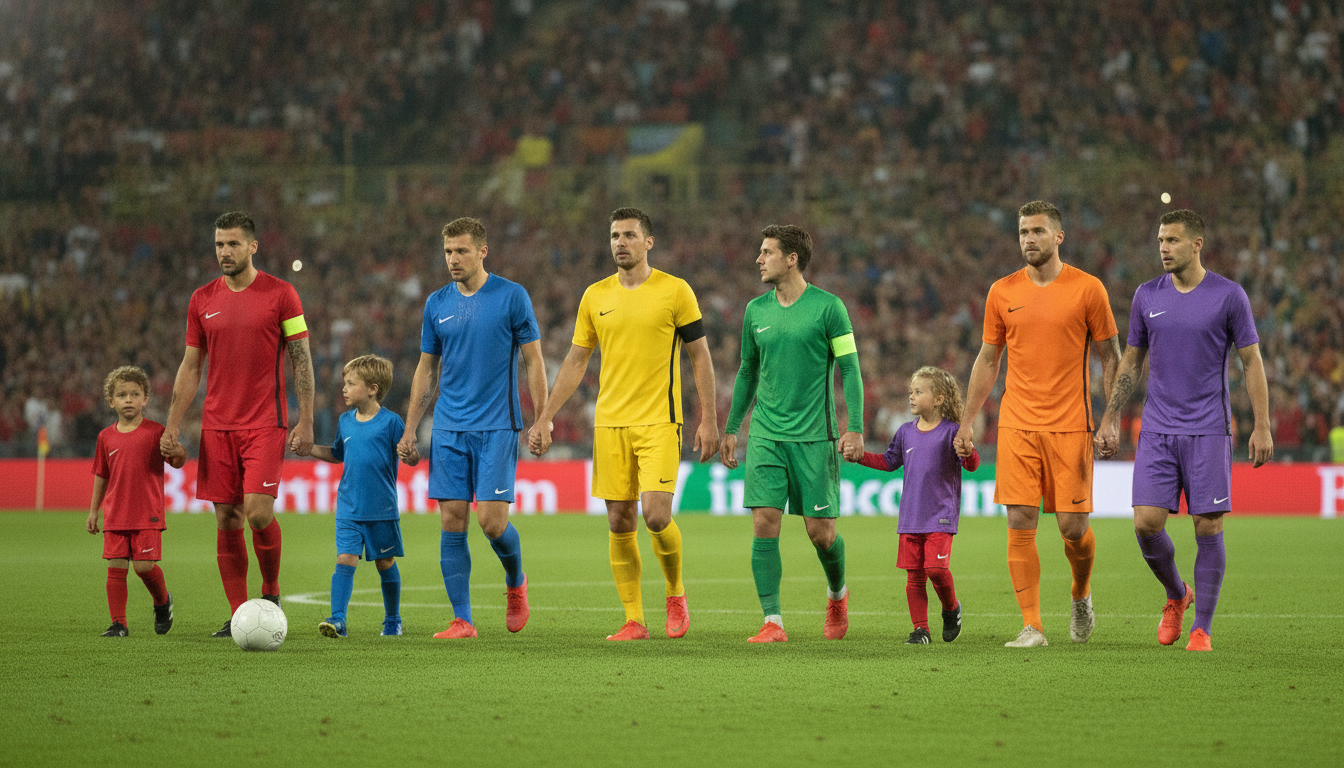
Why do football players walk out with kids?
Why do football players walk out with kids?
Before kick-off, a child in an oversized replica kit steps onto the pitch alongside a professional footballer, gripping their hand as the crowd noise builds. The answer involves a commercial package, a community programme, and a club's very deliberate image management.

Just before the teams emerge from the tunnel, a line of children — usually wearing the home club's kit, often several sizes too big — files out beside the players. Each child holds a player's hand or walks close to their shoulder. They stand through the handshakes, face the cameras, and then peel away to the side of the pitch as the match begins.
Those children are called mascots or player escorts, and the short answer to why they are there is that clubs put them there on purpose — partly as a commercial product, partly as a community gesture, and partly because it reinforces the image clubs want to project.
The most straightforward route onto that pitch is through a club's commercial operation. Many clubs sell mascot packages as part of their sponsorship and hospitality offer. A family pays a fee, and in return their child gets the full experience: the walk-out, a photograph with the players, sometimes a seat in the stand and a signed shirt. For the club, it is a reliable way to generate income from something that costs very little to provide.
Not every spot is sold, though. Clubs also give mascot places to children through charity partnerships, community schemes, links with local schools, and arrangements with hospitals. A child who has been seriously ill, or whose family has a connection to a cause the club supports, might be offered the experience at no cost. These allocations tend to be quieter — clubs do not always publicise them — but they are common enough that most clubs run both streams at once.
The tradition works on a few levels beyond the immediate transaction. For the child, walking out in front of a full stadium alongside a professional player is the kind of memory that does not fade. For the family watching from the stands, it builds a connection to the club that is hard to manufacture any other way. Clubs understand this: a child who has that experience is likely to remain a supporter for life, and so are the people who came to watch them.
The family-friendly image it projects matters too. Football crowds have a complicated history, and clubs have spent decades trying to broaden their appeal beyond the traditional matchday audience. Children on the pitch at kick-off is a visible, broadcast signal that the ground is a place for families.
The one thing worth knowing that most people do not think to ask: the child walking out with the goalkeeper is not necessarily there for a different reason than the one beside the striker. Pairings are usually assigned by the club on the day, sometimes by player preference, sometimes at random. The child has almost never met the player before that moment in the tunnel.


The day's football, in your inbox at 7 AM. Nothing else.
Pick of the night's matches, what the transfer window's doing, and the one column you should read today. No ads. No tips. No operators.
One-click unsubscribe. We do not share emails.
Comments
Loading comments…