
 FUL1
FUL1 MAN1
MAN1 BOU0
BOU0 LIV1
LIV1 LEE0
LEE0 CRY0
CRY0 MNC5
MNC5 SUN3
SUN3 NFO0
NFO0 COV1
COV1 BHA3
BHA3 ARS0
ARS0 EVE1
EVE1 IPS0
IPS0 NEW2
NEW2 HUL1
HUL1 TOT2
TOT2 AVL3
AVL3 NOR3
NOR3 BOL4
BOL4 WOL1
WOL1 WBA0
WBA0 BIR2
BIR2 MID2
MID2 BUR1
BUR1 DER1
DER1 LCN1
LCN1 SWA2
SWA2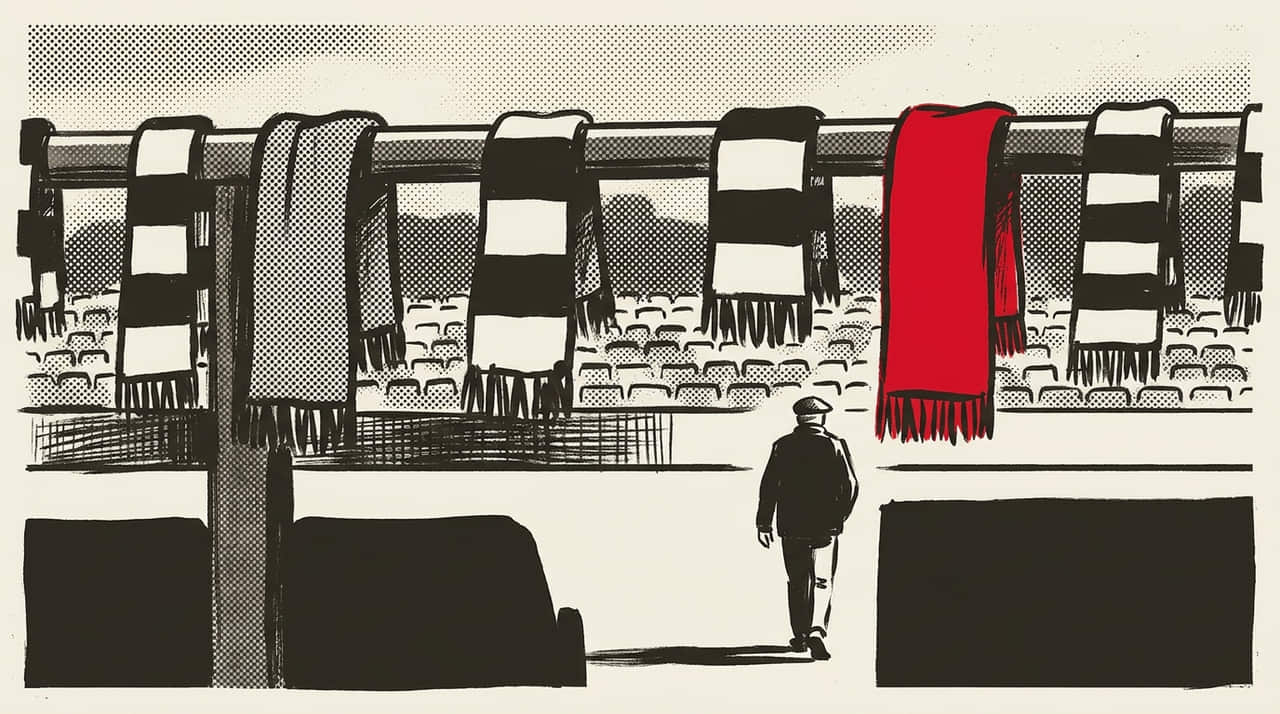
ILLUSTRATION — FLAGSIDE
Why Messi never judged himself on goals alone
Messi is widely understood to see a great game as more than scoring twice and calling it a day. The philosophy attributed to him describes a different scoreboard, one built on touches, decisions and control rather than the one everyone else is watching.

What Messi is actually saying
Strip away the modesty and the idea is a specific claim about how a footballer should judge themselves. Messi's version of a good game is built on feeling comfortable on the ball, staying involved in the buildup, making the right decision under pressure and not giving the ball away cheaply. Goals, in this framing, are a byproduct of that state, not the proof of it. It draws a line between output (the number that ends up in the match report) and process (the ninety minutes of small decisions that produce it, or don't).
It's a useful distinction because the two things can diverge badly. A striker can score twice from two scraps of half-chance while giving the ball away a dozen times and never influencing the game in open play. By this measure, that's not a great game, whatever the scoresheet says. Equally, a No.10 can go ninety minutes without a shot, dictate every phase of possession, and by that standard have played superbly.
Why this matters more for a player like Messi
The distinction isn't universal advice for every position. A penalty-box striker's job description is genuinely closer to 'score the goal and nothing else matters', and plenty of legendary careers were built on exactly that ruthlessness. Messi's case makes most sense for a player whose value has always come from involvement: how often he touches the ball, how he manipulates space between the lines, how rarely he loses possession in dangerous areas. For that kind of footballer, goals are the visible tip of a much larger contribution, and judging the whole game by the tip undersells everything underneath it.
It also explains something about how Messi's worst nights get talked about. Games where he scored but felt anonymous for long stretches are said to have bothered him more than games where he created without finishing. The internal scorecard this describes rewards control and involvement over the moment of finish, which is a much harder thing for anyone outside the dressing room to actually measure.
The gap between the eye test and the stat sheet
This also points to a quiet flaw in how football is consumed. Headlines, highlight reels and post-match ratings are built almost entirely around goals and assists because they're the easiest thing to count and show. A player who spends ninety minutes making the pass before the pass, drawing two defenders out of position, or simply never wasting a single touch, rarely gets the same credit unless someone is watching closely enough to notice.
That gap between what shows up on a stat sheet and what actually wins matches is precisely why elite players and coaches tend to talk in this language rather than the highlight-reel version. Involvement, decision-making and ball retention are the currency that keeps a team functioning for the full ninety, even on nights when the finishing doesn't arrive. A team can dominate every metric that matters and still lose to a smash-and-grab, and a front three can be handed two tap-ins on an otherwise anonymous night. Only one of those tells you anything about how well the team actually played.
Control over the ledger
This isn't about dismissing goals, it's about refusing to let them be the whole conversation. The measure described here is closer to control of the ninety minutes than to the ledger at the final whistle, and it's a standard that's much harder to fake. A striker who nicks two goals from nothing can get away with calling it a great game. The bar Messi is reputed to hold himself to sits somewhere the highlights reel doesn't reach: touches taken, balls kept, decisions made well, over and over, whether or not the ball ends up in the net.

The day's football, in your inbox at 7 AM. Nothing else.
Pick of the night's matches, what the transfer window's doing, and the one column you should read today. No ads. No tips. No operators.
One-click unsubscribe. We do not share emails.
Comments
Loading comments…