
 FUL1
FUL1 MAN1
MAN1 BOU0
BOU0 LIV1
LIV1 LEE0
LEE0 CRY0
CRY0 MNC5
MNC5 SUN3
SUN3 NFO0
NFO0 COV1
COV1 BHA3
BHA3 ARS0
ARS0 EVE1
EVE1 IPS0
IPS0 NEW2
NEW2 HUL1
HUL1 TOT2
TOT2 AVL3
AVL3 NOR3
NOR3 BOL4
BOL4 WOL1
WOL1 WBA0
WBA0 BIR2
BIR2 MID2
MID2 BUR1
BUR1 DER1
DER1 LCN1
LCN1 SWA2
SWA2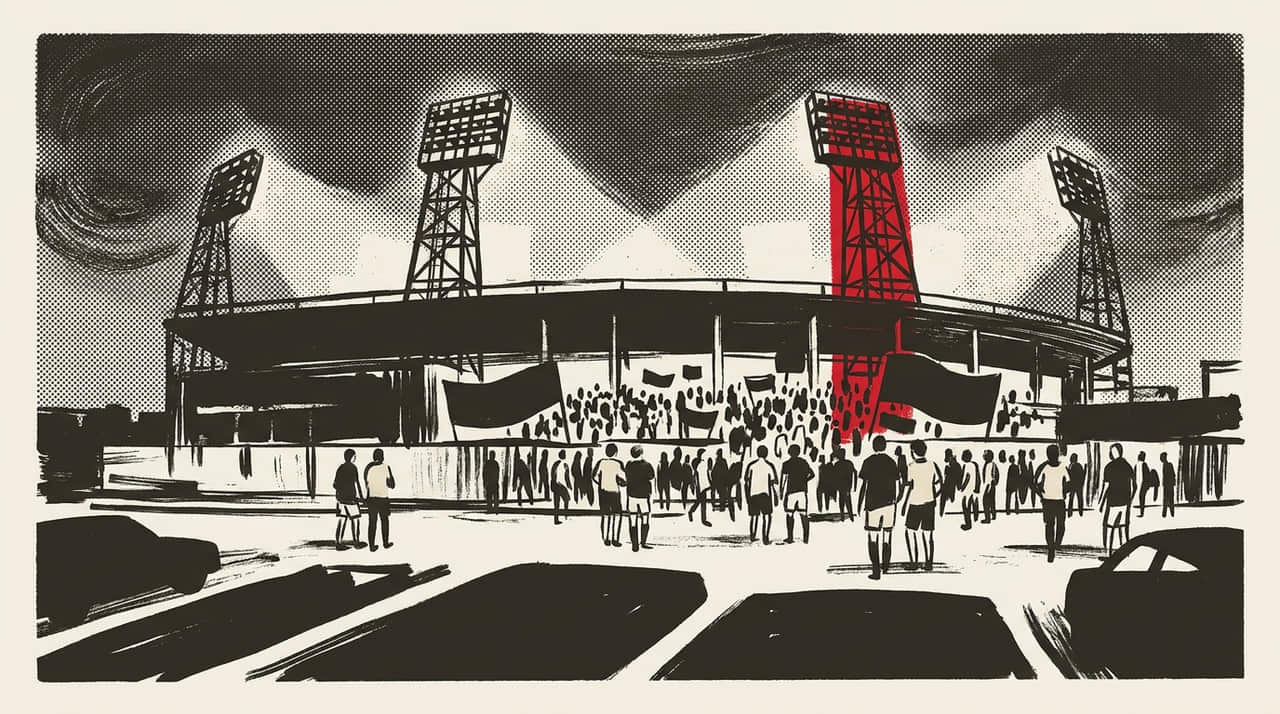
ILLUSTRATION — FLAGSIDE
The Bundesliga's dominance problem, properly explained
The Bundesliga has a genuine competitive problem, and it is not a new one. Bayern Munich's run of consecutive titles stretched across more than a decade, and even in the seasons when a challenger briefly emerged, the gap closed again before it mattered. The league is not broken, but it is lopsided in a way that most of Europe's top divisions are not.

How Bayern got so far ahead
The gap between Bayern Munich and the rest of the Bundesliga was not built overnight. It is the product of sustained commercial dominance, a scouting network that consistently outperforms its rivals, and a habit of signing the best players from direct competitors. Borussia Dortmund develop a generational talent, Bayern watch carefully, and more often than not the player ends up in Munich. Robert Lewandowski did it. Mario Götze did it. Mats Hummels went back and forth. The pattern is well established.
This is not unique to Germany. Juventus did it in Serie A for years. PSG have done it in Ligue 1. But the Bundesliga's version of the problem is particularly visible because the gap between Bayern and the chasing pack has been so consistent for so long. A decade-plus of consecutive titles does not happen by accident.
Why the 50+1 rule does not fix it
Germany's 50+1 ownership rule, which requires that member clubs retain majority voting rights, is often held up as a model for fan governance. And in terms of protecting clubs from the kind of reckless private ownership that has destabilised clubs elsewhere in Europe, it has genuine merit. But it does not solve the competitive imbalance problem, and it arguably makes it harder to close the gap.
Clubs in the Premier League can attract sovereign wealth investment or billionaire backing that transforms their spending power inside a few transfer windows. In the Bundesliga, that route is largely closed. The clubs that were big before 50+1 remain big. The clubs that were small remain constrained. Bayern, whose commercial revenues dwarf everyone else in the division, operate in a different financial ecosystem to the rest of the league.
There are exceptions carved into the rule, most notably for investors who have been involved with a club for more than twenty years, which is how Bayer Leverkusen's relationship with the Bayer corporation and Wolfsburg's with Volkswagen persist. But those are legacy arrangements, not new money.
When a challenger actually arrived
Bayer Leverkusen's title win in the 2023-24 season was the most significant disruption to Bayern's dominance in years. Leverkusen went the entire domestic league season unbeaten, which is an extraordinary achievement by any measure, and Xabi Alonso's side played football that was genuinely different in character to anything else in Germany. It was a real break in the pattern.
What it also showed, though, is how rare that kind of alignment has to be: a brilliant coach at exactly the right moment, a squad that peaked together, and Bayern going through a transitional period simultaneously. All three things had to be true at once. That is not a structural fix. It is a perfect storm.
The television money gap
The Bundesliga's domestic broadcast deal is substantial, but it distributes money in a way that does not dramatically compress the gap between the richest and poorest clubs. Bayern's global commercial revenues, from kit deals, sponsorship and their own international fanbase, sit on top of whatever the broadcast pool provides. A club in mid-table receives their share of the domestic deal and not much else. The distance between those two positions is significant and does not close easily.
The Premier League's broadcast distribution model, for all its faults, does more to keep its bottom half financially competitive with its top half than the Bundesliga's equivalent does. That is one reason why Premier League relegation battles tend to be tighter than Bundesliga ones.
What the league does well
None of this means the Bundesliga is without merit. Dortmund's stadium atmosphere is among the best in European football. The league produces technically excellent players and has a strong record of developing young talent. Clubs like Freiburg and Union Berlin have punched well above their weight for sustained periods. The football is often fast and open in a way that makes it watchable even when the title is already decided.
The problem is specifically at the top. A league where the champion is known in February is a league with a competitive problem, whatever else it does well. The Bundesliga knows this, and has known it for years. The solution, if one exists, requires either Bayern to weaken or the rest to find a way to grow faster. Neither looks imminent.



The day's football, in your inbox at 7 AM. Nothing else.
Pick of the night's matches, what the transfer window's doing, and the one column you should read today. No ads. No tips. No operators.
One-click unsubscribe. We do not share emails.
Comments
Loading comments…