
 FUL1
FUL1 MAN1
MAN1 BOU0
BOU0 LIV1
LIV1 LEE0
LEE0 CRY0
CRY0 MNC5
MNC5 SUN3
SUN3 NFO0
NFO0 COV1
COV1 BHA3
BHA3 ARS0
ARS0 EVE1
EVE1 IPS0
IPS0 NEW2
NEW2 HUL1
HUL1 TOT2
TOT2 AVL3
AVL3 NOR3
NOR3 BOL4
BOL4 WOL1
WOL1 WBA0
WBA0 BIR2
BIR2 MID2
MID2 BUR1
BUR1 DER1
DER1 LCN1
LCN1 SWA2
SWA2
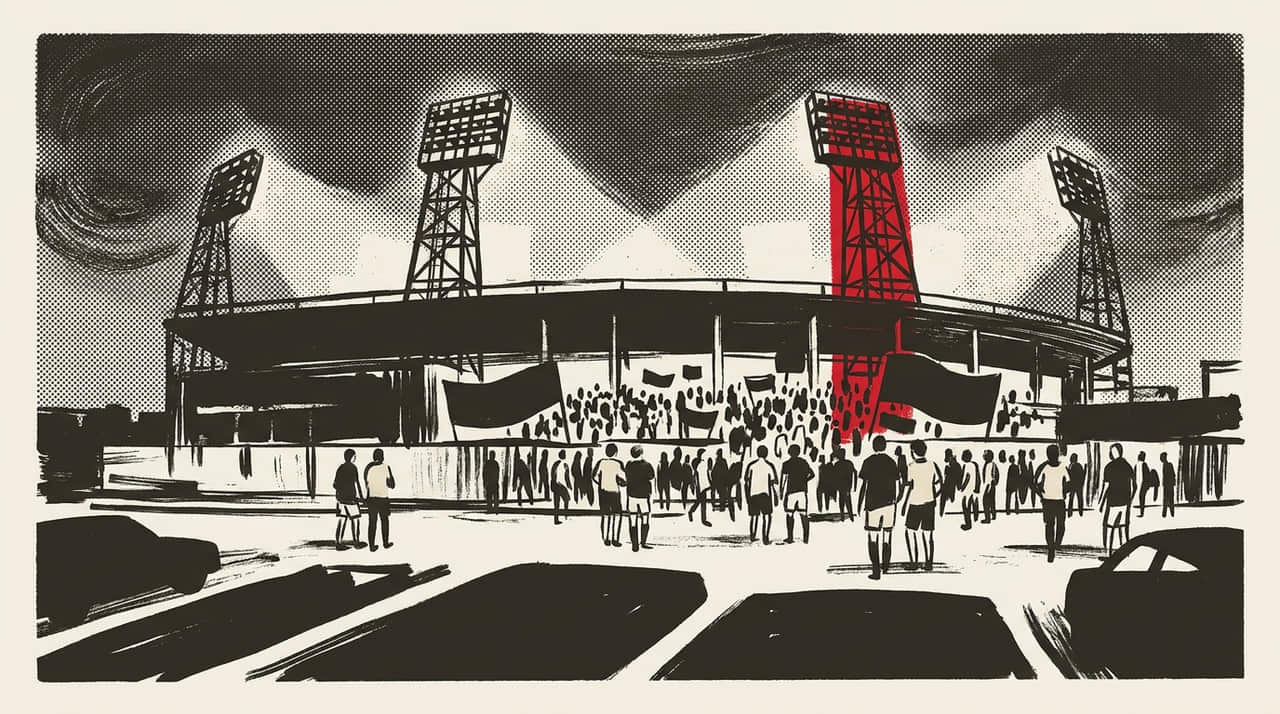
Photo: Ank Kumar via Wikimedia Commons (CC BY-SA 4.0)
How Bayern Munich built a club that doesn't borrow
Bayern Munich have posted a profit every year for more than three decades. No bank debt, a stadium they own outright, and wages that sit well inside UEFA's limits. The structure behind that record is deliberate — and it comes with real constraints.

The starting point is ownership. FC Bayern München AG is 75% owned by the member club, FC Bayern München e.V. Adidas, Audi and Allianz each hold 8.33%. That is not a passive arrangement, those three corporate partners paid roughly €275 million for their stakes, and Bayern put that money into the Allianz Arena and the club's training campus rather than into the transfer market. Infrastructure first, players second.
The stadium itself opened in 2005 at a cost of about €340 million. Bayern cleared the debt on it in 2014, nine years into a repayment schedule that was supposed to run to roughly 25. Paying off a building that fast, while continuing to compete at the top of European football, requires the kind of revenue certainty that most clubs do not have. Bayern get it partly through the way they sell sponsorship: long, multi-year deals rather than annual renewals. That extended planning horizon is what makes the debt repayment possible.
The wage bill is the clearest sign of how the model holds together. Bayern run player and staff wages at about 45-50% of revenue. UEFA sets a guidance ceiling of 70%. Barcelona, at the worst of its financial crisis, went past 80%. That 20-plus-point gap below the UEFA ceiling is what gives Bayern the headroom to absorb a bad season without a fire sale, a buffer Barcelona did not have when it was forced to let Lionel Messi leave in 2021.
The academy is part of the same logic. Jamal Musiala and Aleksandar Pavlovic both came through Bayern's youth system into the first team. Every player developed internally is a transfer fee the club does not spend. That keeps the wage-to-revenue ratio manageable and means the club is not permanently dependent on the market to replace quality.
None of this means Bayern are insulated from the economics of European football. The broadcast-rights gap with England is significant and structural. Bayern draw roughly €90-95 million a year from Bundesliga television rights. The club that finishes 20th in the Premier League, last place, relegated, draws more: roughly €105-115 million. That gap does not close through good financial management. It is a function of market size, and Bayern cannot spend their way around it.
The 50+1 rule compounds the constraint. German football requires that the member association retains majority control of any club, which rules out the kind of majority outside ownership that has reshaped Bayern's main European rivals. No state-backed investor, no billionaire with a controlling stake. The member club stays in charge. That protects the model from the short-termism that outside owners often bring, but it also caps the ceiling on external capital. Bayern cannot be bought and recapitalised the way Manchester City or Paris Saint-Germain were.
The club has built something genuinely durable: no bank debt, more than 30 consecutive profitable years, a stadium paid off in less than half the time originally scheduled. But the Bundesliga's broadcast revenue sits below what the Premier League pays its relegated clubs, and the 50+1 rule closes off the ownership routes that have funded Bayern's main rivals. Self-sustaining, yes. On a level playing field with Manchester City or PSG, no.
Sources2 sources
Klaas Ripken, Photo: Ank Kumar via Wikimedia Commons (CC BY-SA 4.0)
Flagside's editors read every piece we publish. We work from the football press, write our own copy rather than reprinting anyone's, and check each article for accuracy and sourcing. Every outlet that fed into this piece is named under Sources.


The day's football, in your inbox at 7 AM. Nothing else.
Pick of the night's matches, what the transfer window's doing, and the one column you should read today. No ads. No tips. No operators.
One-click unsubscribe. We do not share emails.
Comments
Loading comments…