
 FUL1
FUL1 MAN1
MAN1 BOU0
BOU0 LIV1
LIV1 LEE0
LEE0 CRY0
CRY0 MNC5
MNC5 SUN3
SUN3 NOR3
NOR3 BOL4
BOL4 WOL1
WOL1 WBA0
WBA0 BHA1
BHA1 AVL1
AVL1 CRY0
CRY0 TOT7
TOT7 WHU0
WHU0 EVE1
EVE1 CEL0
CEL0 RAN1
RAN1 NCD0
NCD0 SOL2
SOL2 FIJ
FIJ VAN
VAN DMA
DMA AIA
AIA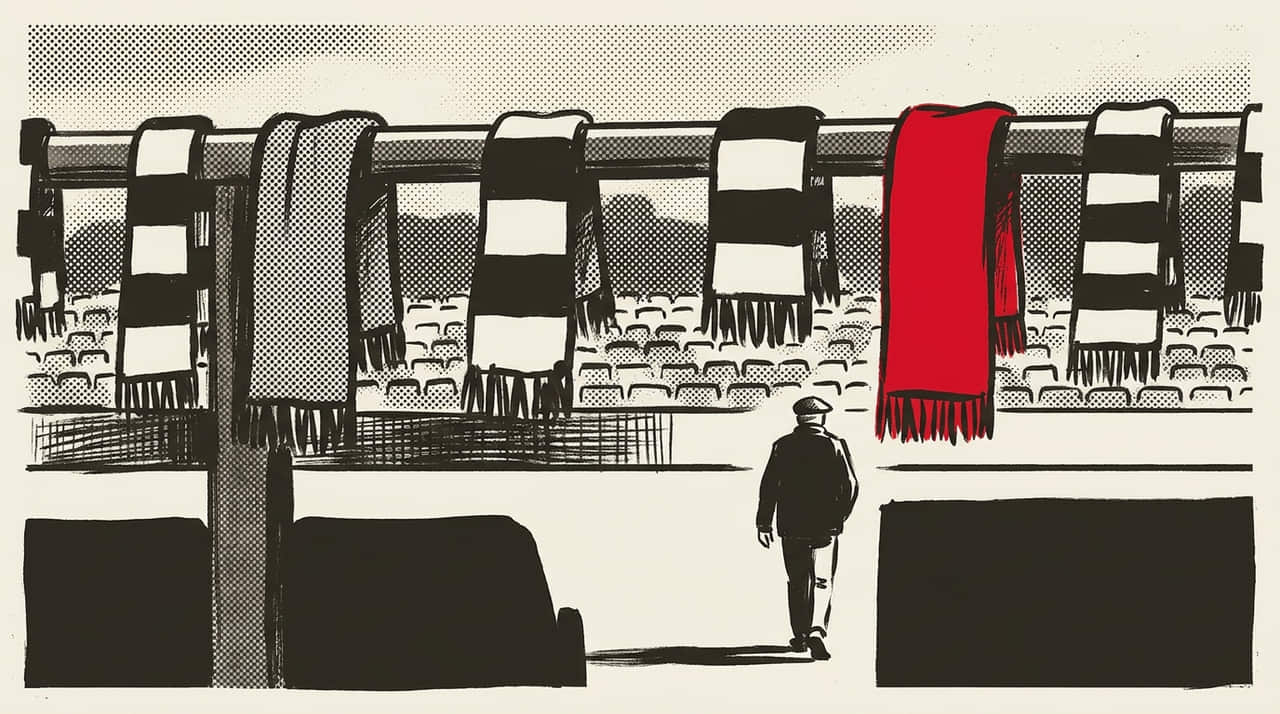
ILLUSTRATION — FLAGSIDE
The clubs that fell furthest: how Portsmouth's decline became historic
Falling one division is a bad season. Falling two is a crisis. Falling through the entire English football pyramid across the better part of a decade is something else entirely, and Portsmouth did exactly that. Their trajectory from the upper reaches of the Premier League in the late 2000s to the bottom half of League Two by the mid-2010s is probably the most sustained institutional collapse in modern English football history.

What makes a decline 'consecutive'
The question is specific: not just which club has fallen furthest overall, but which has finished lower in its domestic pyramid every single season without interruption. A club can get relegated and bounce straight back up, and that resets the streak. To hold a record here, a club has to keep sinking, year after year, with no recovery season breaking the run.
Portsmouth's case is the benchmark. From a respectable Premier League finish in the late 2000s, the club descended through every tier of the English pyramid, landing in the bottom half of League Two by the mid-2010s. Season after season of finishing lower than the one before, across the better part of a decade. That is not just relegation; that is the systematic dismantling of a football club in real time.
Why Portsmouth fell so far
The reasons are well documented even if the full picture took years to emerge. Portsmouth's Premier League era was built on ownership structures and financial arrangements that could not sustain themselves. The club changed hands repeatedly, each transaction leaving the books in worse shape than before. When the money stopped, everything stopped with it.
Administration followed, then points deductions, then further administration. Points deductions do not just cost you a season; they accelerate relegation and make rebuilding almost impossible because the financial penalties compound the sporting ones. By the time Portsmouth were playing in the lower reaches of the Football League, the club had been through a process that stripped it of stability at every level: playing staff, management continuity, infrastructure investment, and supporter confidence.
No single catastrophic event explains it. There was no one bad season or one disastrous decision. It was a cascade, each problem making the next one harder to solve.
Why England produces these extremes
The English football pyramid is unusually large and unusually competitive. Four fully professional divisions below the Premier League, each with promotion and relegation, means there is further to fall than in most European systems. A club that loses its financial footing in the top flight can, in theory, keep dropping through the Championship, League One and League Two without ever finding a floor that stops the slide.
In many other countries, the professional pyramid is shorter. The distance between the top division and the lowest professional tier is simply smaller, so the longest possible consecutive decline is structurally capped. England removes that cap. It is not that English clubs are more badly run than clubs elsewhere; it is that the system gives badly run clubs more room to fall.
Turkish football has its own history of clubs suffering severe financial and governance failures, and some of those cases have produced dramatic drops through the domestic pyramid. But the Turkish professional structure, while competitive, does not offer quite the same number of consecutive steps downward.
Barnsley, Tranmere and the active cases
Barnsley and Tranmere have both recorded several consecutive seasons of finishing lower in the pyramid without interruption. That is a serious run. Several seasons of decline means a club has not managed a single stabilising year across a significant stretch of time, and the psychological and structural damage that accumulates over that period is hard to overstate.
Whether either can approach Portsmouth's record depends entirely on whether the causes of their decline get addressed. Portsmouth's collapse lasted as long as it did because the problems were structural and financial rather than purely sporting. A club with bad ownership and unserviceable debt does not fix itself by signing better players; it fixes itself by resolving the underlying problem, which often takes years and sometimes requires supporter ownership or external intervention to achieve.
Can Portsmouth's record be beaten?
A run of consecutive decline stretching across the better part of a decade is extraordinarily difficult to approach, let alone surpass. To beat it, a club would need to keep finishing lower every single season for even longer, with no recovery campaign interrupting the run. Given how hard it is to sustain any consistent direction in football, even a downward one, that requires a very specific combination of financial collapse, governance failure and structural instability.
The record probably can be matched, somewhere in a large enough pyramid, by a club whose problems run deep enough. But it requires everything to go wrong simultaneously and stay wrong for years. Portsmouth's decline was a governance story and a financial story as much as a football one, and the community paid the price throughout.

The day's football, in your inbox at 7 AM. Nothing else.
Pick of the night's matches, what the transfer window's doing, and the one column you should read today. No ads. No tips. No operators.
One-click unsubscribe. We do not share emails.
Comments
Loading comments…